Meridian
What changes when an option's underlying is a probability?
Artifacts
- Research note
- Notebook
- Calculator
- Source
Question
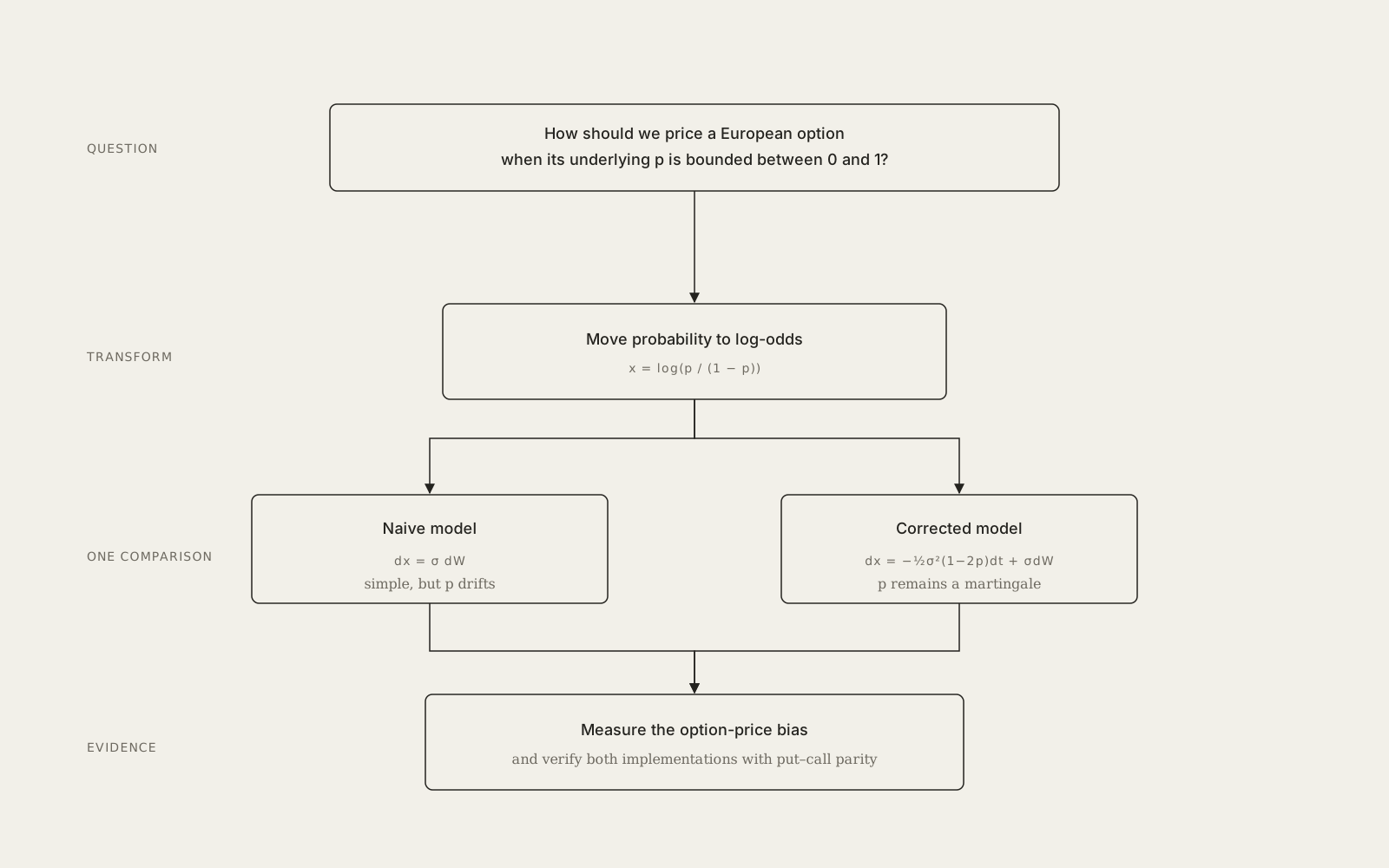
Black–Scholes starts with a positive, unbounded stock price. A prediction-market contract is different: its price is a probability between zero and one. Meridian asks one question: how should that boundary change the model and the option price?
Approach
The project maps probability p to log-odds x = log(p/(1-p)), where ordinary diffusion tools apply. It then uses Itô's lemma to show that driftless motion in x does not make p a martingale, derives the required drift correction, and compares the naive and corrected option prices.
Core experiment
A deterministic Gauss–Hermite calculation prices the simple logit-normal model; Monte Carlo prices the drift-corrected reference model. The main output is a bias curve showing when the simpler assumption stops being harmless, checked against put–call parity.
Things I got wrong
The first version grew into a trading platform before the pricing assumption was settled. More importantly, it treated a driftless logit as if it implied a driftless probability. The sigmoid is nonlinear, so that claim fails by Itô's lemma and Jensen's inequality.
Future work
Greeks, implied volatility, jumps, market calibration, and trading infrastructure are intentionally outside the core study. They only become useful after the bounded martingale model is understood and validated.